Asphalt Contractor Anderson Call (765) 347-9479
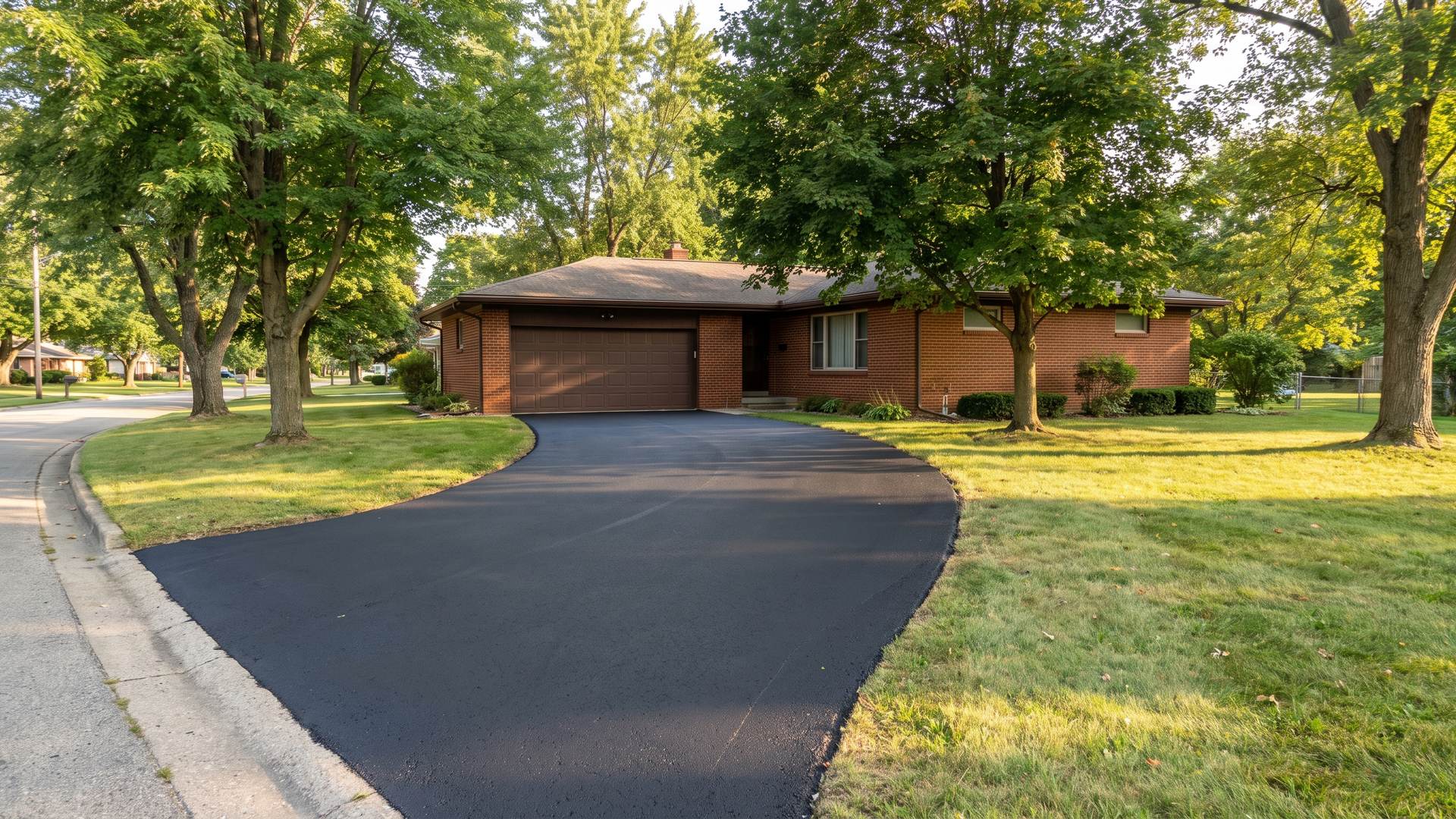
A freshly paved black driveway curves from the curb to the garage of a brick ranch under tall shade trees on a quiet Anderson street

Asphalt Contractor Anderson

(765) 347-9479

Free Anderson quotes for driveways, lanes and lots.

Asphalt Paving and Driveway Contractors in Anderson, IN

Half of Anderson's homes were standing by about 1961, so many drives here have been through six decades of freeze and thaw. Here is what paving, resurfacing or replacing one involves, and what it costs.

  • INDOT rules need 60F air to place hot mix thinner than one inch
  • Madison County maintains about 870 miles of road and 220 bridges
  • A drive in Anderson's right-of-way needs a city permit, bond and insurance
Anderson paving

Asphalt Paving for Anderson Driveways, Lanes and Lots

Asphalt paving in Anderson is mostly a replacement market. The city reached 70,787 people in 1970, when General Motors employed close to 22,000 workers across its Anderson plants, and the median house in town dates from about 1961. A driveway first laid in that era may well have been patched, sealed and overlaid more than once by now. The question its owner faces is rarely cosmetic. It is whether the stone underneath can carry one more surface, or whether the whole section has to come out and be rebuilt from the base up.

This site covers the jobs an asphalt contractor around Anderson is asked to price: new driveways and full replacements, overlays that put fresh asphalt on a sound base, repairs to broken sections, and commercial parking lots. Outside the city limits the questions change, so there are pages for gravel and millings drives, tar and chip, the grading and culverts that let a rural drive meet a county road, and paving for long private lanes. Each page explains the work, the local conditions that decide how it holds up, and what separates a careful bid from a cheap one.

Prices on this site are observed market ranges from published cost guides, set out on the Anderson asphalt cost page with the square footage each figure assumes. They are not quotes. A paving contractor can only price a job after measuring it, looking at how water leaves the site and probing what sits under the old surface, which is why the quote form asks for size, access and the current condition of the drive.

Timing matters here as much as price. Indiana's highway specifications tie the temperature needed to lay hot mix to the thickness of the layer, and Anderson's own weather record shows how quickly the window narrows. The local paving data page lays out those numbers month by month, alongside the soil and permit facts that shape a job before the first truck of asphalt arrives.

Free quote

Fields marked * are required.

Fast response during business hours. No obligation.

Paving work

Nine Kinds of Asphalt Work Anderson Owners Ask About

Steam rises as a compact paver spreads hot asphalt along a residential driveway beside a trimmed lawn and a low ranch house

Asphalt Driveway Paving

New asphalt driveways for Anderson homes, from gravel conversions to new construction, built on a stone base sized for central Indiana's wet clay ground.

Typical: $5 - $15 per sq ft installed; about $2,000 - $4,800 for a 400 sq ft pad

Broken slabs of an old driveway sit piled on the lawn while a skid steer waits beside a freshly graded crushed stone base

Driveway Replacement

Tear-out and repave for Anderson driveways whose base has failed: the old asphalt or concrete comes out, the stone underneath is rebuilt, and new hot mix goes down on firm ground.

Typical: $8 - $15 per sq ft for tear-out and repave; removal alone about $1 - $2 per sq ft

The thick edge of a new asphalt overlay rests on top of old pavement covered in a web of fine cracks

Asphalt Resurfacing

Overlays for worn but structurally sound Anderson driveways and lots: a new layer of hot mix over the old surface, with edges milled so it meets the garage and street cleanly.

Typical: $3 - $7 per sq ft; about $1,200 - $5,000 for a typical driveway overlay

A square patch of fresh black asphalt stands out on a worn gray driveway, a plate compactor parked beside it

Asphalt Driveway Repair

Crack filling, pothole patching and edge repair for Anderson asphalt drives that are still sound underneath, done before freeze and thaw turn small damage into a rebuild.

Typical: Crack filling $1 - $3 per linear ft; patching $2 - $5 per sq ft, or about $100 - $500 per patch

A roller sits at the far end of a newly paved parking lot in front of a single-story brick office building

Parking Lot Paving

New and rebuilt asphalt lots for Anderson businesses, churches and apartment buildings, designed for truck traffic, drainage and the accessible spaces federal rules require.

Typical: $2.50 - $7 per sq ft for a paved lot; about $10,000 for a small 10-car lot

A long crushed stone lane runs past a cornfield toward a farmhouse and a red barn on a sunny afternoon

Gravel & Millings Driveways

Crushed stone and recycled asphalt millings drives for long lanes, farm access and parking pads around Anderson, built with a crown and a base that can handle wet clay.

Typical: Gravel about $1,800 on average ($500 - $3,500); millings $3 - $8 per sq ft installed

Close view of a tar and chip drive, light stones set in black binder, curving toward a white farmhouse and a board fence

Tar & Chip Driveways

Tar and chip surfaces for long lanes and farmhouse drives around Anderson: hot liquid asphalt sprayed over a firm base with stone rolled into it, sealed against water and dust.

Typical: $1 - $5 per sq ft; single seal about $2 - $3, double seal about $3 - $5 per sq ft

A corrugated metal culvert pipe carries a roadside ditch under a stone field drive beside a two-lane country road

Driveway Grading & Culverts

Grading that sends water off a drive instead of into it, and culvert pipes where rural drives cross a roadside ditch, done before any stone or asphalt goes down around Anderson.

Typical: Grading about $1,000 - $2,500 for a typical drive; culvert replacement $1,000 - $9,000

A newly paved private lane winds between a tree line and a soybean field toward a white farmhouse and barn at dusk

Private Road & Lane Paving

Paving and rebuilding for shared drives, long farm lanes and private streets around Anderson, built like small roads with a crown, ditches and a section sized for trucks.

Typical: Hot mix about $5 - $15 per sq ft; tar and chip $1 - $5 per sq ft; millings $3 - $8 per sq ft

Why This Site Starts With Anderson's Ground and Rules

Built on Anderson's own numbers

The weather figures come from the Anderson sewage plant station, the soil descriptions from federal soil surveys of the central Indiana till plain, and the permit rules from the City of Anderson and INDOT. A reader can see why a base that works in a sandy county fails here, and what a bid should include because of it.

Prices shown before anyone calls

Every dollar figure on this site is an observed market range from a named cost guide, with the size and scope it assumes. Knowing that a two-car driveway commonly runs a few thousand dollars, and what pushes it higher, makes it easier to judge a quote from any paving company in Madison County.

Independent contractors, one request

The quote form goes to an independent paving contractor that works in Anderson and the surrounding towns. That company measures the job, prices it and does the work under its own name. There is no charge to ask, and nothing on this site commits anyone to hire.

The rules explained up front

Right-of-way permits, bonds, state highway culverts and the 811 locate law all add days and cost to a paving job. Each service page explains which of them apply, so a start date is not lost to a missing permit or a gas line nobody marked.

The job

How a Paving Job Runs From Estimate to First Drive

  1. Measure and look underneath

    A contractor measures the square footage, checks where water runs and ponds, and probes the old surface for soft spots. On older Anderson drives the key question is the base: how thick it is, whether clay has worked up into it, and whether it can carry a new surface.

  2. Permits and utility locates

    Work that reaches the street needs the city's right-of-way permit, or an INDOT or county permit on those roads. Any excavation waits for an 811 locate, requested at least two full working days ahead, so that gas, water and cable lines are marked before digging starts.

  3. Build or rebuild the base

    Old asphalt is broken out and hauled away, the subgrade is shaped and rolled, soft areas are dug out, and compacted crushed stone is placed, commonly six to eight inches for a driveway. The finished grade is set so water runs off the surface and away from the garage.

  4. Pave, roll and wait

    Hot mix is spread at temperature and compacted with a roller while it is still workable, usually two to three inches thick on a driveway. Cars stay off for several days, turning wheels in place is avoided for weeks, and sealcoating waits at least 90 days.

Local conditions

What Anderson's Soils, Weather and Streets Do to Asphalt

Most of Anderson sits on the glacial till plain of central Indiana, where federal soil surveys describe three common kinds of ground. Miami soils drain moderately well but hold a perched water table two to three feet down from December into April. Crosby soils stay wetter, with water as close as half a foot below the surface in winter and spring. Brookston soils fill the low spots and drain poorly, with the water table sometimes standing at the surface. A driveway built across that mix can be dry at the garage and saturated at the street, and the base has to be designed for the wet end.

Water arrives often. The long-running weather station at the Anderson sewage plant records 41.44 inches of precipitation in a normal year, with May and July the wettest months at more than 4.4 inches each. Winter brings about 19.6 inches of snow, and January's average low is 19.3 degrees. That combination is what breaks asphalt from below: water soaks into a thin or clay-fouled base in the fall, freezes, lifts the pavement, then leaves it unsupported when it thaws in spring.

The age of the housing stock compounds the problem. Anderson grew fastest during the decades when Delco Remy and Guide Lamp were the city's two largest employers, and a driveway from that period may have carried three surfaces since. Each overlay adds height at the garage and the street without adding support underneath. When fresh asphalt goes over a base that has lost its strength, the old cracks tend to reflect up through the new layer within a few winters, which is why a bid for an overlay can turn into a full replacement once the old asphalt is cut open and the stone below is examined.

Rules depend on which road the driveway meets. Inside the city, the City Engineer's office requires a permit, a bond and proof of insurance for any work on a private drive or sidewalk that sits in the road right-of-way, which covers most aprons and curb cuts. A drive onto a state route such as State Road 9 or State Road 32 needs an INDOT driveway permit, and INDOT calls for a culvert of at least 15 inches under private drives and field entrances unless it approves something else. County roads fall under the Madison County Highway Department, which maintains roughly 870 miles of roadway.

The city has been repaving its own streets. Anderson received a $970,000 Community Crossings grant from INDOT in 2024 to pave streets in the Greenbriar and Meadowbrook neighborhoods and Pearl Street south of 14th Street, part of about $11 million the city has drawn from the program since 2016. When a street in front of a house is milled and repaved, the grade at the gutter can change, and the driveway apron is the part of the private drive that has to meet it.

Beyond the city limits, Madison County is farm country with long lanes, field entrances and ditch-lined county roads. Gravel, recycled asphalt millings and tar and chip are common there because they cost less per square foot than hot mix over a long distance, and each needs a culvert where the drive crosses the roadside ditch. Before any digging for a culvert, grading or a new base, Indiana law requires a locate request through 811 at least two full working days in advance.
Pricing

What Asphalt Paving Costs Around Anderson

These are observed market ranges for asphalt work, drawn from national cost guides published in 2026 (HomeGuide and Angi) and applied to the kinds of jobs Anderson owners ask about. They are not quotes. A paving contractor prices a specific site after measuring it, checking drainage and looking at the base under the old surface, and in Anderson the base is where most of the variation comes from. Use the table to judge whether a bid is in a sensible range, then read the factors below to see why yours may sit high or low.

Service Typical Anderson Range
New asphalt driveway, installed $5 - $15 per sq ft
Two-car pad, about 400 sq ft $2,000 - $4,800
Driveway replacement, tear-out and repave $8 - $15 per sq ft
Removing an old asphalt driveway $1 - $2 per sq ft
Questions

Asphalt Paving Questions From Anderson Owners

How much does a new asphalt driveway cost in Anderson?

National cost guides put a new asphalt driveway at roughly $5 to $12 or more per square foot installed, and Angi's 2026 figures run $7 to $15 including labor. A 400 square foot two-car pad lands near $2,000 to $4,800 at the lower guide's rates. Replacing an old drive adds removal, commonly $1 to $2 per square foot, and any base repair. The full price table breaks these figures out by job type.

When is paving season in Anderson?

Most residential asphalt paving in Anderson happens from late April or May through October. INDOT's placement rules require 60 degrees for hot mix less than an inch thick, 45 degrees for layers of one to two inches and never a frozen base. The Anderson station's normal lows are 41 degrees in April and 43 in October, falling to 34 in November, so thin overlays belong in the warmer months.

Does a driveway in Anderson need a permit?

The city's published rule covers the part of a drive that sits in the road right-of-way: work on the apron, curb cut or sidewalk there requires a permit, a bond and insurance through the City Engineer's office. Widening a drive or adding a new one can also raise zoning questions, so it is worth a call to the city before work starts. Drives onto state routes need an INDOT permit, and county roads are handled by the Madison County Highway Department.

How thick should an asphalt driveway be?

Cost guides describe a standard residential driveway as two to three inches of compacted asphalt over six to eight inches of compacted gravel base. In Anderson the base deserves more attention than the top layer, because poorly drained Crosby and Brookston soils hold water close to the surface in winter. Where a drive crosses wet ground, extra stone, fabric and drainage do more good than extra asphalt.

Should an old Anderson driveway be resurfaced or replaced?

Resurfacing makes sense when the damage is at the surface and the base is still firm: fading, shallow cracks, minor raveling. Replacement is the better call when there are deep cracks, potholes, sunken areas or water problems, or when repairs would cost close to half the price of a new drive. On many 1950s and 1960s driveways the base is the weak point, which pushes the answer toward driveway replacement.

How long does an asphalt driveway last in central Indiana?

Published estimates run 15 to 30 years, with about 20 years as a common figure. The low end is typical where water sits under the base or the drive was built thin. The high end takes a well-drained base, cracks filled early, a sealcoat every few years once the asphalt has cured, and no heavy trucks parked on the edges.

How soon can a car go on new asphalt, and when can it be sealed?

Contractors usually ask owners to keep cars off fresh asphalt for several days and to avoid turning the steering wheel while parked for the first few weeks, especially in hot weather. Sealcoating should wait at least 90 days, and a sealer supplier recommends nine to twelve months, because sealing too early traps the oils that are still leaving the new surface.

Is tar and chip or gravel cheaper than asphalt for a long country drive?

Usually, per square foot. Angi's 2026 figures put tar and chip at $1 to $5 per square foot and installed asphalt millings at $3 to $8, against $7 to $15 for new hot-mix asphalt, and a typical gravel driveway averages about $1,800. The trade-offs are upkeep and life span: gravel needs regrading, tar and chip needs a new seal layer about every ten years, and loose stone travels.

What does an asphalt company need to know to give a quote?

Any asphalt company pricing the job needs the measurements, or a rough idea of length and width, the current surface, where the drive meets the road, and any spots where water stands after rain. Photos of cracks and low areas help. For rural drives, mention the ditch and whether a culvert is already in place. The quote form collects these details and sends them to an independent contractor who can arrange a site visit.

Does this site do the paving work itself?

No. Asphalt Contractor Anderson is an independent referral site. It explains paving work and local rules, publishes observed price ranges, and passes quote requests to an independent asphalt contractor that serves Anderson and Madison County. That company quotes the job and performs it under its own name, and the terms of any work are between the owner and that contractor.

Service area

Anderson and the Towns Around It

Anderson, IN Edgewood, IN Chesterfield, IN Pendleton, IN Lapel, IN Alexandria, IN Elwood, IN Frankton, IN Ingalls, IN Markleville, IN Daleville, IN Middletown, IN Summitville, IN Country Club Heights, IN Woodlawn Heights, IN River Forest, IN Fortville, IN

Get a Paving Quote in Anderson

Describe the driveway, lane or lot, its rough size and where it meets the road. The request goes to an independent paving contractor in Madison County.

Free quote

Fields marked * are required.

Fast response during business hours. No obligation.